
Need help with fire alarm systems?
Contact Us → Get a Quote →
ADDRESSABLE + CONVENTIONAL
Fire Alarm Systems
Classified as a Life Safety System, the primary purpose of a Fire Alarm System is to issue notification messages and signals that warn of potential dangers and prompt occupants to take appropriate action.
In the event of a fire, a Fire Alarm System is designed to alert all building occupants, whether they are inside or outside.
Notifications can also be directed to designated personnel, both onsite and offsite. These may include security guards, facilities managers, monitoring companies, or building owners.
When an emergency occurs, a Fire Alarm System ensures prompt notification of emergency responders, such as the local fire department.
Designed to reach three key groups: building occupants, designated personnel, and emergency responders, a Fire Alarm System “casts a wide net” of life-saving alerts, prompting necessary human response.
It ensures those who need to step out of harm’s way or step into it are informed as quickly as possible. Ultimately, a Fire Alarm System enhances occupant safety while safeguarding property and assets.
Notification Appliances
For building occupants, Fire Alarm Systems use notification appliances to emit distinct messages and signals, including audible tones and horns, prerecorded voice messages, visually displayed text messages, and synchronized flashing strobe lights.
Audible and visible notification appliances are designed to share critical instructions for occupants, such as to evacuate the building during a fire, shelter in place because of severe weather, or enact lockdown procedures in case of security threats.

Some of the available audible and visible fire alarm notification appliances used in Autocall Fire Alarm Systems.
For building occupants, Fire Alarm Systems use notification appliances to emit distinct messages and signals, including audible tones and horns, prerecorded voice messages, visually displayed text messages, and synchronized flashing strobe lights.
Supervising Station
The current status of a Fire Alarm System is automatically transmitted to a remote monitoring organization, called a Supervising Station. Here, trained operators are in attendance at all times and ready to respond to any signal indicating an abnormal condition.
Depending on the type of signal received, whether it’s an alarm, trouble, or supervisory condition, a Supervising Station can notify and dispatch the local fire department or call designated personnel from a prioritized contact list.
With a Fire Alarm System under the watchful eyes of an experienced monitoring company, prompt and appropriate actions are ensured 24/7, even outside regular business hours.
Emergency Control
A Fire Alarm System designed with Emergency Control Functions can automatically control other interconnected building systems, including releasing fire doors to contain a fire, managing HVAC fans and duct dampers to stop the spread of smoke, and coordinating with elevators to bring them to designated floors for a safe evacuation
FIRE ALARM SYSTEM APPLICATIONS
Apartment buildings. Commercial facilities. Convention centers. Correctional occupancies. Data centers. Day-care. Dormitories. Education campuses. Grocery stores. Health care facilities. High-rise buildings. Historic landmarks. Hospitals. Hotels. Industrial. Laboratories. Manufacturing sites. Malls. Multi-building centers. Multi-unit residential. Nursing homes. Office buildings. Parking structures. Restaurants. Religious buildings. Schools. Sports complexes. Transportation hubs. Tunnels. Underground facilities. Warehouses.
Design + Install
Fire Defense’s NICET-certified designers and installers design, install, and commission Fire Alarm Systems that meet customers’ life safety objectives while complying with all applicable fire and life safety codes.
ITM
Fire Defense technicians are trained to conduct periodic inspections, testing, and maintenance for Fire Alarm Systems in accordance with manufacturer and code requirements.
Emergency Service
Available 24/7 for emergency Fire Alarm System service. Fire Defense facilities and service trucks are stocked with spare fire alarm system components to expedite repairs.
Codes and Standards
Whether installing a new Fire Alarm System or performing ITM services, Fire Defense ensures full compliance with NFPA standards, national building and local codes, manufacturer guidelines, customer specifications, and AHJ requirements.
Note: NFPA makes its codes and standards available online for free. Select View Free Access under Current & Prior Editions and create a free account.

Fire Defense installing flame-resistant cabling as part of a new fire alarm system installation in a newly constructed assisted living facility.
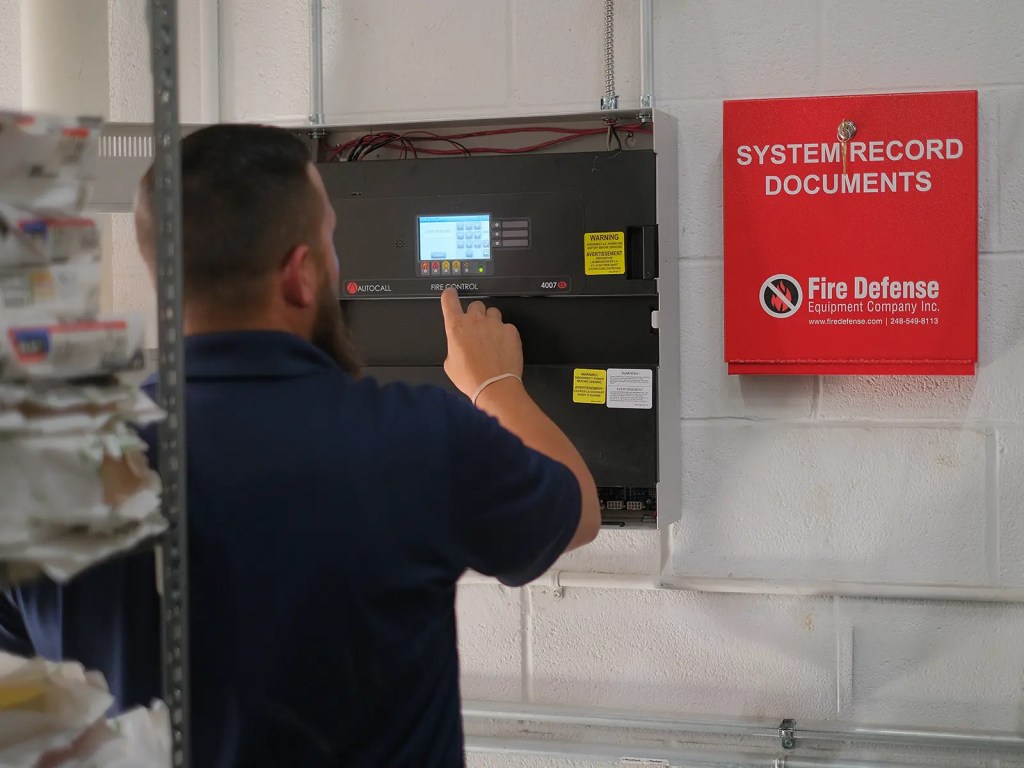
A Fire Defense technician performs final system checks at the fire alarm control panel during the completion of a dedicated function Fire Alarm System installation.

During a routine Fire Alarm System inspection, a Fire Defense technician identifies a deficiency affecting a manual pull station.
Initiating Devices
Fire Alarm Systems require initiating devices to activate. Automatic detectors, supervisory switches, and manual pull stations are the most commonly used initiating devices.
Automatic Detectors
With no human intervention, detection devices can automatically identify hazard conditions, such as the presence of smoke, heat, or toxic gas.
A Fire Alarm System with addressable detectors can pinpoint the exact location of an activated detector within the building, enabling quicker hazard assessment

A Fire Defense demonstration panel gives customers a hands-on way to explore Fire Alarm System design options and observe system functionality in real time.
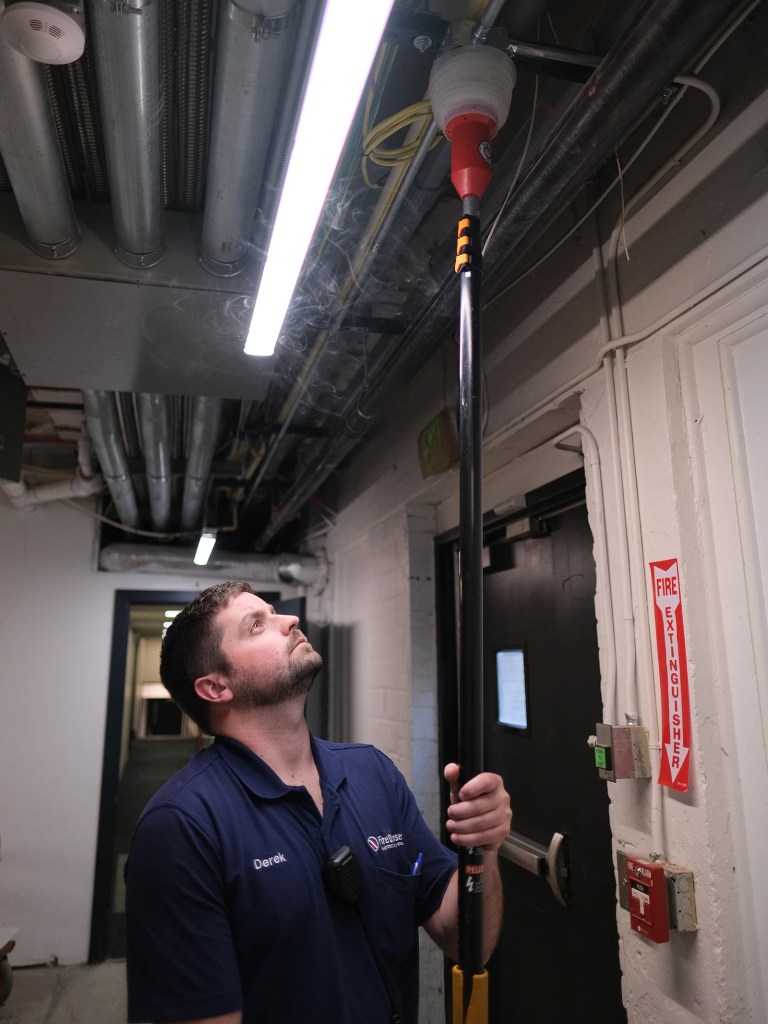
A Fire Defense technician tests an automatic smoke detector during a scheduled fire alarm system inspection to verify proper detection and system response.
Supervisory Switches
Fire Alarm Systems can automatically monitor the operational state of other independent building systems and equipment.
Supervisory Signal Initiation Devices, better known as Supervisory Switches, detect critical conditions such as generator failures or emergency lighting malfunctions during self-tests, as well as any abnormal changes within a Fire Sprinkler System

A Fire Defense technician is wiring a Supervisory Signal Initiating Device on a Fire Sprinkler System water control valve. This Sprinkler System is now monitored by the building’s Fire Alarm System.
If a water control valve is closed—whether intentional or accidental—in a monitored Fire Sprinkler System, this potentially dangerous situation does not go unnoticed. A connected Supervisory Switch, specifically a tamper switch, will trigger a ‘supervisory condition, alerting specified personnel.
If waterflow is detected or a fire pump activates, a connected Supervisory Switch will trigger an ‘alarm condition,’ summoning the Fire Department.
Building systems under the continuous oversight of a Fire Alarm System not only remain ready for emergencies but also become a vital part of an interconnected safety network dedicated to protecting lives and assets.
Manual Pull Stations
Manual pull stations, also called pull boxes, allow for building occupants to manually activate a Fire Alarm System.
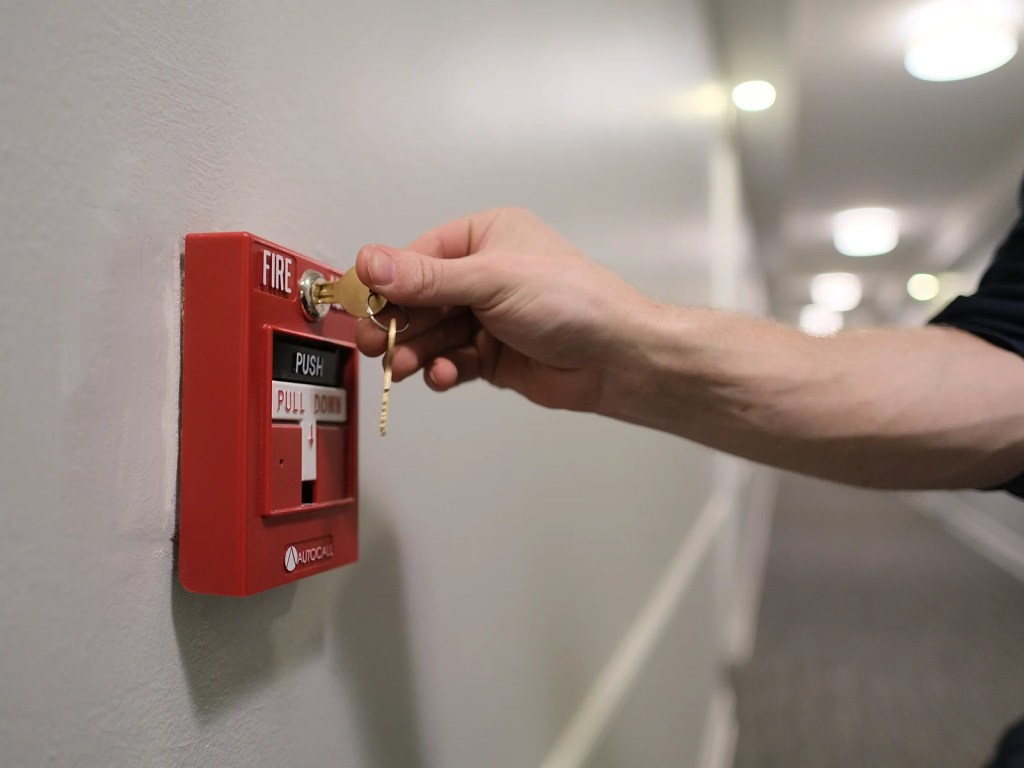
During a fire alarm system inspection, a Fire Defense technician tests a manual pull station and resets the device using the manufacturer-required key after activation.
Questions and Answers
Who remotely monitors Fire Defense Alarm Systems?
We have partnered with a UL-listed remote monitoring organization that operates from three monitoring stations. In the event one station is down due to a natural disaster or power outage, your fire alarm system will remain monitored.
For which Fire Alarm System manufacturers does Fire Defense conduct inspections, testing, and maintenance?
Fire Defense technicians are experienced with servicing all major Fire Alarm System brands, including Autocall, Farenhyt, Silent Knight, Fike, Fire-Lite, Potter, Honeywell, Siemens, Johnson Controls, Notifier, Kidde, Gamewell-FCI, Bosch and others.
Fire Defense designs and installs Fire Alarm Systems from which manufacturers?
Fire Defense primarily focuses on designing and installing new Autocall Fire Alarm Systems. Autocall is the only manufacturer offering fully addressable Fire Alarm Systems with addressable notification appliances. A fully addressable system offers numerous benefits, both in terms of system design and user experience. It provides a long-term, future-proof investment for most customers. Backed by Johnson Controls, Autocall benefits from a long-standing reputation for building some of the best Fire Alarm Systems on the market.
What are some of the benefits of a fully addressable Fire Alarm System?
A fully addressable Fire Alarm System offers key advantages, including reduced wiring for faster installation, self-testing notification appliances, and real-time communication with the Fire Alarm Control Unit (FACU). Each device reports its exact status and location, streamlining maintenance, reducing false alarms, and enabling selective alarm activation. With improved diagnostics, easier expansion, and long-term reliability, addressable systems provide a future-proof solution for most facilities.
Can a fire alarm system be designed for buildings where normal daily activities—such as manufacturing processes, dust, steam, or intermittent smoke—could cause false alarms during occupied hours, but still provide higher sensitivity during off-hours?
Fire alarm systems can use programmable smoke detectors with adjustable sensitivity levels. These detectors can automatically change sensitivity based on time of day or occupancy schedules. During normal operating hours, sensitivity can be reduced to minimize nuisance alarms caused by routine activities. During nights, weekends, or other low-activity periods, sensitivity can increase to provide earlier fire detection. This approach balances reliable fire protection with normal day-to-day operations while maintaining code compliance.