
Need help with Fire Suppression Systems?
Contact Us → Get a Quote →
FIRE SUPPRESSION SYSTEMS
Clean Agent
Clean Agent Fire Suppression Systems discharge either halocarbon or inert gases that effectively disrupt one or more of the four components required for combustion to occur (heat, fuel, oxygen, or the chemical chain reaction).
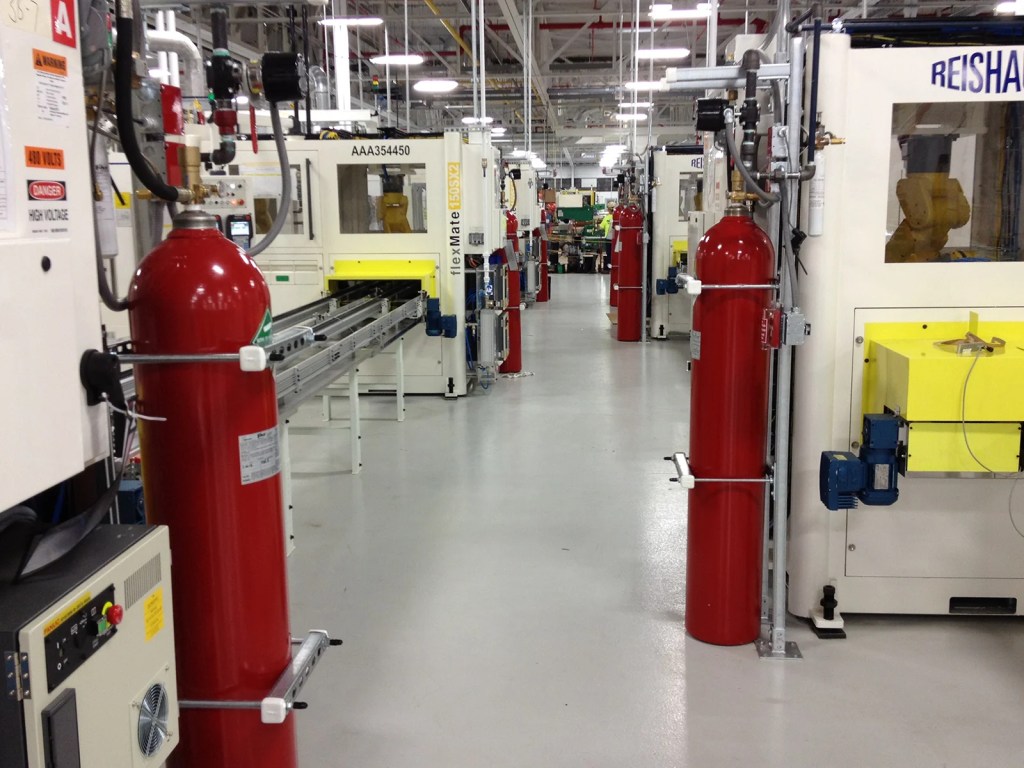
Several Clean Agent Fire Suppression Systems are protecting grinders and their manufacturing processes. These automatic fire suppression systems prevent downtime and are safe for the equipment. The cylinders for these systems utilize a 50/50 mix of nitrogen and argon gases.
The term “clean agent” refers to fire suppressing gases that are electrically non-conductive, non-corrosive, evaporate easily, and leave no residue to clean-up.
Clean Agent Fire Suppression Systems are generally safe to use in occupied spaces. However, reduced oxygen levels always present some degree of risk. Proper agent concentration calculations, discharge delays, warning signage, audible and visual pre-discharge alarms, and room venting are all critical elements of system design.

Door warning signage for a Clean Agent Fire Suppression System, a manual discharge pull and abort button have been installed to the left of the door, and to the right you can see orange VESDA air sampling piping, which this Clean Agent System is using as its detection.
CLEAN AGENT APPLICATIONS
Data rooms. Cable spreading rooms. Electronic hazards. Enclosed energy systems. Engine test stands. Flammable liquid storage. Enclosed grinders. Microwave relay stations. Robotic paint spray areas. Shipboard cargo holds. Switch-houses. Pump rooms. Telecommunications. Test chambers. Transformer bays. Unattended vaults. UPS rooms. Utility tunnels.
CLEAN AGENT TYPES
Argon. Ansul Sapphire. ECARO-25. FE-25. FE-227. Fike ProInert. Fike SF 1230. FK-5-1-12. FM-200. HFC-125. HFC-227ea. Inergen. IG-01. IG-55. IG-100. IG-541. Nitrogen. Novec 1230.
Design + Install
Fire Defense provides in-house drawings and turnkey installations for Clean Agent Fire Suppression Systems, including room integrity door fan testing, system commissioning, final acceptance testing, and customer orientation.
ITM
Fire Defense technicians perform periodic inspection, testing, and maintenance for Clean Agent Fire Suppression Systems.
Emergency Service
24/7 emergency service is available. Fire Defense technicians are fully equipped with the tools and parts needed to expedite repairs and minimize downtime for Clean Agent Fire Suppression Systems.
Codes and Standards
Fire Defense delivers all Clean Agent System services in full compliance with NFPA 2001, NFPA 72, applicable local and international codes, manufacturer guidelines, customer specifications, and AHJ requirements.
Note: NFPA makes its codes and standards available online for free. Select View Free Access under Current & Prior Editions and create a free account.

Installation of a Fike Clean Agent Fire Suppression System (filled with FK-5-1-12) and a Pre-Action Fire Sprinkler System, which together will protect a Data Center and UPS room. Both suppression systems are monitored by the same control panel.

Part of a total flood Clean Agent Fire Suppression System which protects a test chamber. This system uses one active and one connected reserve argon cylinder mounted to a custom-fabricated floor rack.

A Fire Defense installation in-progress, utilizing a triple-row of Fike ProInert clean agent cylinders to protect multiple enclosures.

In compliance with NFPA 2001, agent quantity and pressure for Clean Agent Systems must be measured during semi-annual inspections. The cylinders above are filled with FK-5-1-12 and are part of multiple Clean Agent Systems protecting a large paint mixing room.
Questions & Answers
How do clean agents suppress a fire?
Halocarbon and inert gas clean agents extinguish fires in different ways. Halocarbon agents primarily absorb heat from the fire, interrupting the combustion process. Inert gas agents reduce the oxygen concentration to a level that prevents combustion while still maintaining an oxygen level that is generally safe for occupied spaces.